DEFEND THE PREMIUM
Product sold as what it demonstrably is
The renewable or specification premium backed by the operation's own record, shared with the buyer on its own terms.
Continuum is a unified, contextualised foundation for the whole of a commodity operation: one industrial knowledge graph holding the physical, commercial and fiscal sides of the business as a single operational model, so the operation owns the definition of its own business rather than assembling it across five systems. Every function works from that model, and every decision, buy, hold, move, blend, sell, fund, cover, commit, is taken against the enterprise rather than one silo.
Beneath the foundation sits the layer the market does not have. The physical half is generated at the source, continuous and in place, and every value carries its computed uncertainty through to custody transfer and settlement. Around the model, the operation's counterparties, its capital and the systems acting on its behalf work from the same record.
Every platform in this market is built to decide and act on figures nobody generated. That is the ceiling the industry works under, and it is where Terrafa starts.
Sold by the data platforms, on figures entered somewhere else.
Delivered to the plant, while the money moves in the commercial layer above it.
Calculated on the market outside, never on the product inside.
Guaranteed at the moment the inspector is present, and nowhere between.
The renewable or specification premium backed by the operation's own record, shared with the buyer on its own terms.
Intakes and outturns read against their paperwork while the parties are still on site.
The margin held back as safety allowance stays in the batch instead of leaving with the product.
Working capital and the borrowing base rest on stock the operation can show, and duty is known at the transaction.
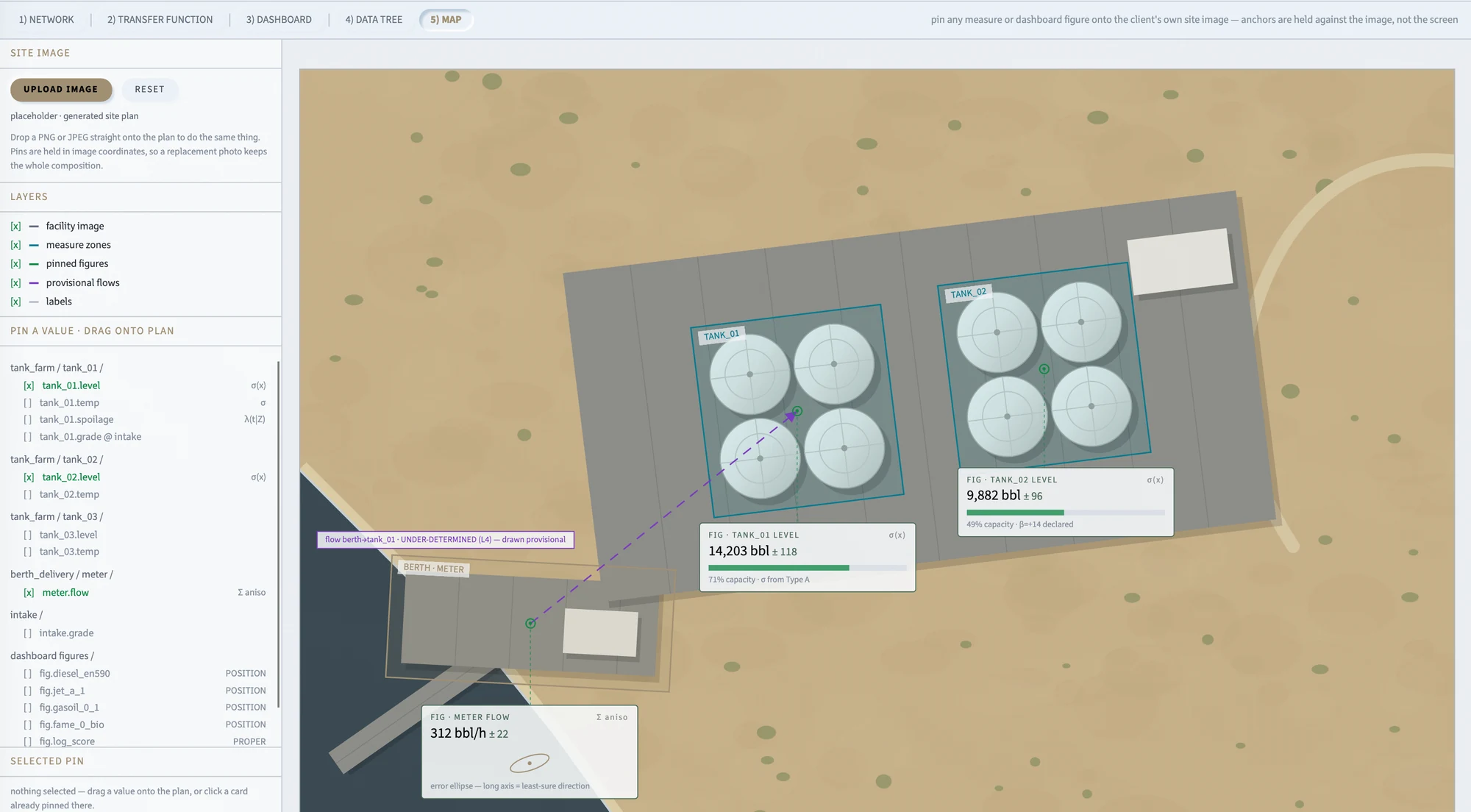
14,203 bbl ± 118. 9,882 bbl ± 96. 312 bbl/h ± 22. No number appears without the confidence attached to it, and the meter's error ellipse names its least-sure direction.
The berth-to-tank flow is under-determined, so it is drawn provisional rather than asserted. The platform shows what it does not know as plainly as what it does.
Readings are pinned onto the operation's own site image in image coordinates.
The mismatch that used to surface three days later becomes a conversation at the gate.
One precautionary retest stands down, another moves up, and the laboratory budget follows the risk.
Tuned on the parcel as it stands rather than on last week's sample.
Priced on what the operation holds, what it is contracted to, and the cash behind it.
One account of the operation, all day, in every seat.
The same objects everywhere: an asset holding product, a movement between assets, a quantity, a quality, a commitment, an obligation.
Five generating sites, one under development for carbon capture. Fuel arrives from several suppliers with moisture, calorific value and contamination declared on certificates. Generation, availability and the obligation sit apart from fuel purchasing.
Reading points at intake and in storage, and one account holding fuel, supplier contracts, generation and the obligation together. Fixed scope, tested against the operation's own history before anything was relied upon.
The gap between what was declared and what was delivered into the boiler, per supplier and per load, in cost per megawatt hour. Moisture variance moving output. Contamination traced to source.
Loads accepted, rejected or repriced on evidence at the gate. Suppliers ranked on what they deliver. Generation planned against the fuel physically present, and exposure under the obligation known at the transaction.
The physical side is read where the product sits, alongside the testing that standards require. Coverage is laid into the operation and maintained as a service, so it is an operating decision rather than a capital project.
Composition and condition read without taking the product anywhere or altering it, across everything an operation handles.
Reading points supplied and maintained by us, priced per point, funded from spend that already exists.
Intelligence built on entered figures stops improving at the quality of its input. Ours improves with every point put in, across every operation.
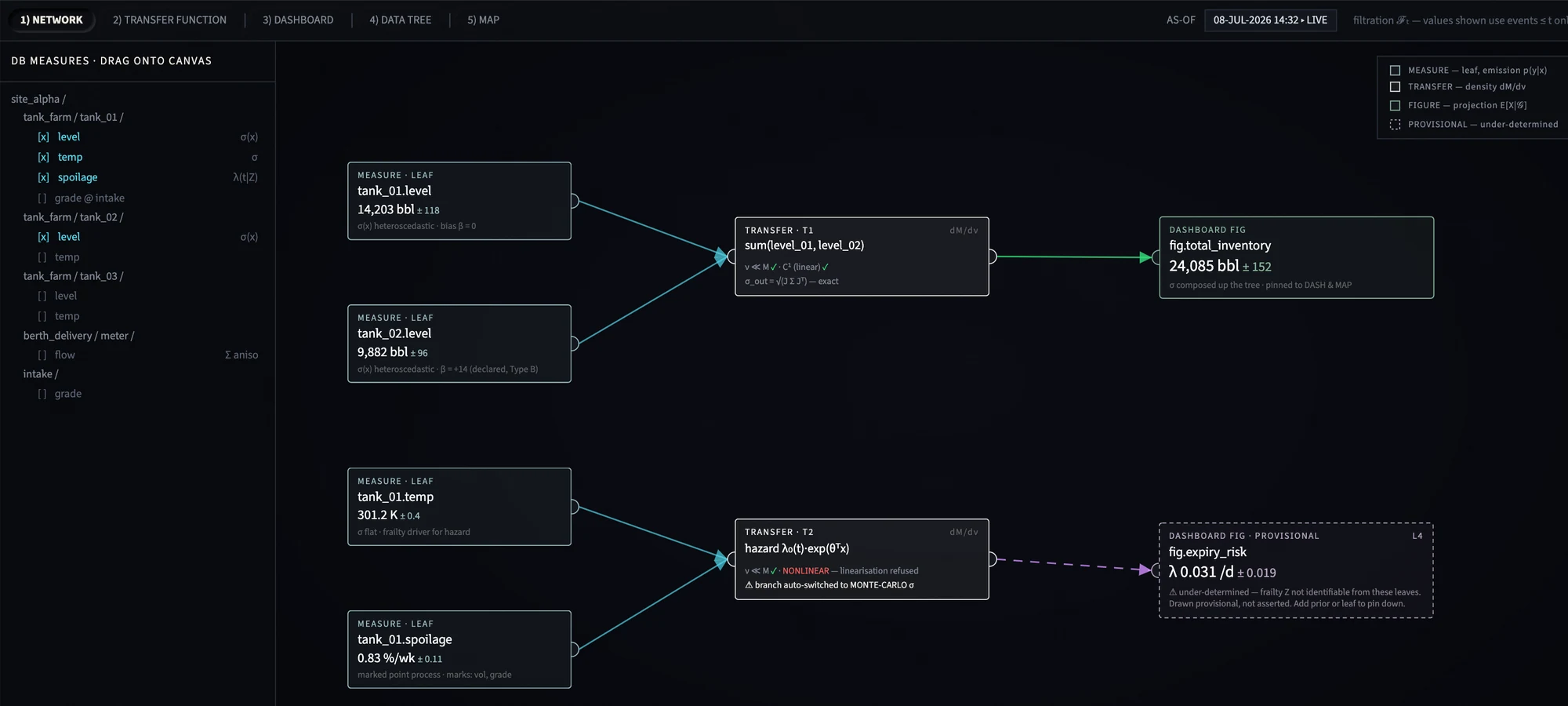
fig.total_inventory reads 24,085 bbl ± 152, composed from two measured tank levels through a declared sum. The figure is not typed in anywhere; it is derived, and the derivation is on screen.
Where the transfer is linear the σ is exact. Where it is not, the platform refuses to linearise and switches that branch to Monte-Carlo rather than quietly approximating.
fig.expiry_risk is drawn provisional: its frailty term is not identifiable from these leaves. The platform states what would pin it down instead of returning a number it cannot stand behind.
Nobody should have to keep track of how good their own numbers are. That job normally falls to whoever remembers which figure came from a fresh reading and which came from a three-week-old certificate. Here it is not a job at all: confidence is carried by the structure, so it survives every step between a reading and a decision without anyone maintaining it.
It is baked in because the graph is measure-theoretic. A leaf is a measure, a transfer is a density against it, and a figure is a conditional expectation E[X|𝒢] — the projection of the quantity onto what is actually known. Every value is adapted to the filtration ℱt, so nothing on screen was computed using information that had not arrived yet.
Which is why linearity is checked rather than assumed. Through a linear transfer, uncertainty propagates exactly: σ_out = √(J Σ Jᵀ) is the answer, not an estimate. Through a curved one the same formula is a first-order approximation that usually understates the spread, so the platform refuses to linearise and switches that branch to Monte-Carlo. Slower, and correct.
Read-first, no replacement and no parallel running. A first operation is live inside a quarter, against acceptance agreed in writing before anything is relied upon.
Read-first connections to the systems the site already runs, and to the files where the working numbers live today.
The physical side produced at the source, with coverage deepening the account wherever the operation wants it.
One account of the operation, reconciled continuously, every figure carrying where it came from and how sure it is.
Every seat gets its own view of the same account: operations, commercial, finance and management.
The platform recommends, acts under authority the operation sets, and declines when the figures do not support the call.
The operation on one account, a view for every seat, and decisions weighed against the whole business.
The account opened outward on the operation's own terms, to customers, counterparties and capital.
The forward view, calibrated against the operation's own record of what actually happened.
Reading points laid in and maintained as a running service, priced per point, deepening the account.
Everything is operating expense. Nothing sits on the balance sheet and nothing waits on central capital approval.
Brings the operation onto the platform against agreed milestones, tested on its own history before it is relied upon.
One operation, one fee, growing as more of the business runs on it. No seats and no per-user arithmetic.
Reading points supplied and maintained as a service on multi-year terms, funded from the testing budget already in place.
The operation sees several times what it pays, against giveaway, demurrage, claims and the working capital tied to stock it cannot show. Rates and a worked example on your own numbers: info@terrafa.uk
They describe the market outside the fence, from cargo movements and reported prices. Continuum describes the operation inside it: what you hold, what it is worth, what you are committed to, and what to do next.
Those organise what the site's instruments already report about the equipment. Continuum holds the product, the contracts, the duty and the cash together, and produces the part of the picture that no existing system holds.
Optimisation improves a plan against the numbers it is given. Continuum decides what those numbers are, and prices the decision against the physical position, the contract and the cash at once.
No. It connects to them read-first and leaves them running. Nothing is ripped out and nothing runs in parallel.
No. Accredited testing is set by standards and stays exactly where it is. Continuum adds continuity between those tests and directs discretionary retesting by exposure rather than by the calendar.
It is the other way round. The operation runs on the platform, and reading points deepen what the platform can see. The platform runs without waiting for them.
It says so. A figure it cannot stand behind is marked as such, and the platform names what would resolve it rather than returning a number that looks certain.
The operation owns its data, and it is never shared, pooled or sold. Figures are served to your analysts, your spreadsheets and your own systems with their reliability attached.
No. A first operation goes live on the systems the site already runs. Coverage is added afterwards, wherever the operation wants the account deepened.
Every value we serve carries where it came from and how sure it is, so a system acting on our account knows when to proceed and when to stop. That is the difference between an agent that acts and an agent that should not.
A UK company answering to operators rather than to an equipment maker's roadmap, with sensing science originating from Imperial College London and advice from King's College London, and a board drawn from refining, advanced fuels and terminal operations.
A first operation is live inside a quarter. Pricing is per operation and per reading point, all of it operating expense. Write to us for rates and a worked example on your own numbers.
Where the money goes when the physical, the commercial and the fiscal are held apart.
Unify, contextualise, decide, act. One shared foundation, and the layer none of them is buying.
The compliance arithmetic moved to physical volume, and the quality risk moved with it.
We build the case on your history before you commit to anything. Write to us and we will scope it.
We talk to operators, partners and investors building toward the same thing: commodity operations that run on figures worth trusting. If your business commits capital against numbers nobody has checked, we should talk.